Overview
The Kundan Cab wire manufacturing process turns raw copper into a finished, tested wire in clear stages, from drawing the copper to insulating, printing and coiling. Each stage sets part of the quality, and the finished wire is tested against Indian standards before it ships. Quality here is built in, not added at the end.
A wire looks simple, but a good one is the result of several careful steps. The copper, the cover and the way they come together all decide how the wire performs for years. Seeing the steps makes it clear where quality is set.
From the raw metal to the reel on the shelf, the process is what turns copper into a wire you can trust. The quality page covers how this is checked. This one covers how it is made.
The Manufacturing Process, Stage by Stage
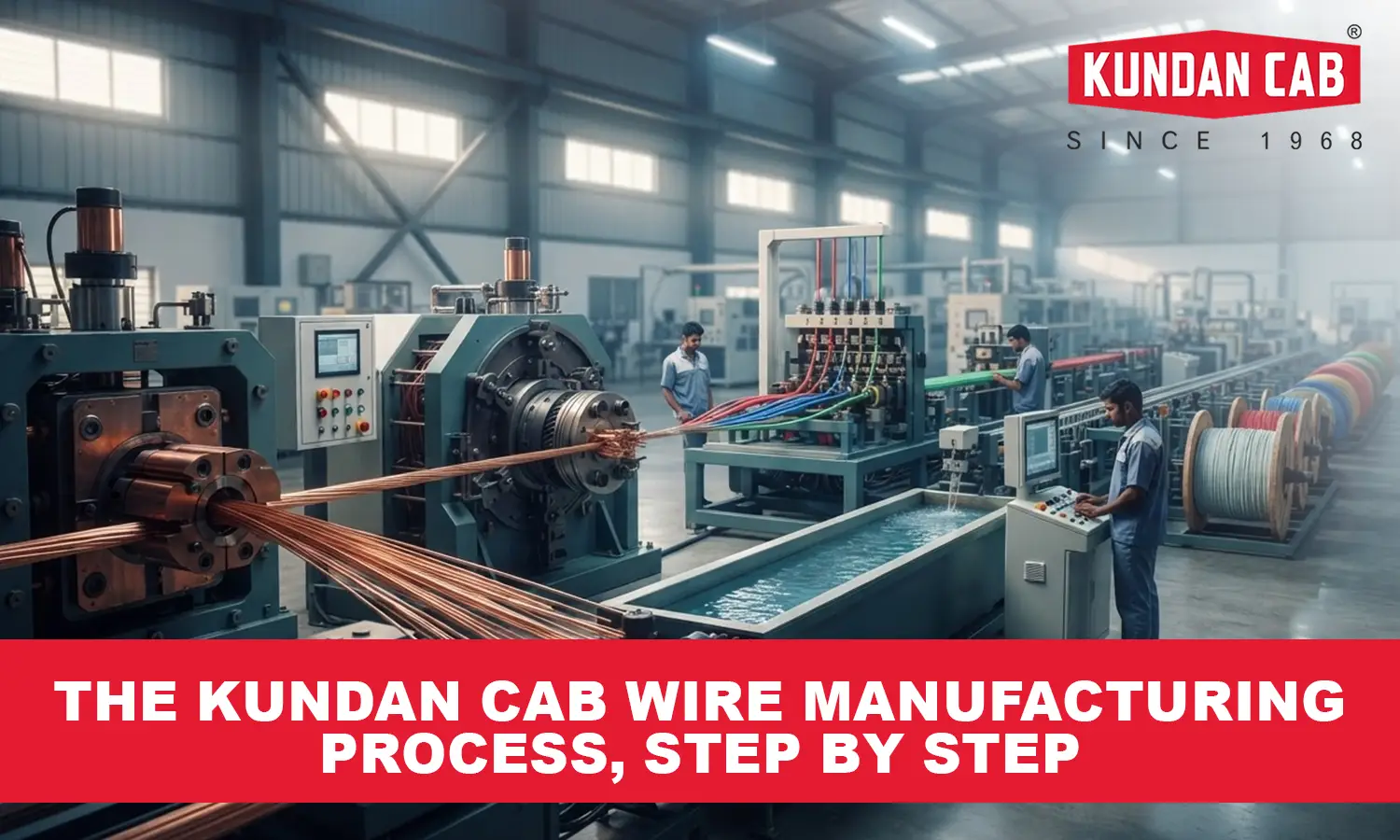
The Kundan Cab wire manufacturing process runs in stages, each building on the last. These are the main wire manufacturing stages.
- Copper drawing: The copper is drawn down to the exact size needed for the conductor.
- Annealing: The copper is softened so the wire stays flexible and easy to work.
- Stranding: Fine strands are twisted for flexible wires, or kept solid for rigid ones.
- Insulation: The chosen cover, FR or FR-LSH, is applied evenly over the conductor.
- Printing and coiling: The brand, size and standard are printed, and the wire is wound onto measured coils.
From Copper to Conductor
The first part of the wire production process is all about the metal. Electrolytic grade annealed copper at 99.97 percent purity is drawn to size, then softened so it bends without breaking. This is the base of a good copper wire manufacturing process, since a clean, high purity conductor is what carries current well and runs cool for years.
Insulation and Finishing
Next comes the cover. In this part of the electric wire manufacturing process, the insulation is applied evenly over the conductor, in the grade the wire is built for, from FR up to the low smoke FR-LSH. An even, well bonded cover is what protects the copper and makes the wire safe to handle. This is where modern cable production technology shows, in a smooth, consistent finish.
Testing and Coiling
The last stage proves the wire before it ships. The copper purity, the conductor size, the insulation and the safe rating are checked against the standard, then the brand, size and standard are printed and the wire is wound onto measured coils. This is where a length of covered copper becomes a finished, certified product.
Why the Process Matters
A careful process is the reason a good wire and a poor one, which look alike on the shelf, behave so differently in use. A slip at any stage would show later as heat or early failure. So the wire manufacturing technology and the care behind it are exactly what a home never has to think about again. For how this quality is checked, see the quality page, and for the range see the full Kundan Cab range.
FAQS
1. How is a Kundan Cab wire made?
The Kundan Cab wire manufacturing process runs from drawing the copper to size, softening it, stranding or keeping it solid, applying the insulation, then printing and coiling. Each of these wire manufacturing stages sets part of the quality, so a controlled process is the base of a reliable wire.
2. What copper is used?
Electrolytic grade annealed copper at 99.97 percent purity. In the copper wire manufacturing process, this clean, high purity metal is drawn to size and softened, so the finished conductor carries current well and runs cool for years.
3. Why does the process matter?
Because a good wire and a poor one can look the same on the shelf, and the difference is in the making. A careful electric wire manufacturing process with testing at the end is what stops a wire overheating or failing early, so the process is really about safety over the life of the wiring.
KEY TAKEAWAYS
- The Kundan Cab wire manufacturing process runs in clear stages from copper drawing to coiling.
- It starts with 99.97 percent copper, drawn to size and softened for flexibility.
- The insulation is applied evenly in the chosen grade, from FR up to FR-LSH.
- The finished wire is tested against the standard, then printed and wound onto measured coils.
- A careful process is what makes a wire safe and long lasting in use.
Want a wire built with care from copper to coil? Look for the ISI mark, the IS 694 standard and the correct Kundan Cab name, and buy from the official brand or an authorised dealer. Visit kundancab.in to see the range and find a dealer near you.