Why Wire Colour Code Is a Safety Standard, Not a Preference
Colour coding in electrical wiring is not decorative. It is a life-safety standard that enables any licensed electrician or emergency responder to instantly identify which wire is live, which is neutral, and which is earth, without any testing equipment. Confusing colour codes during installation have caused electrocutions, fires, and deaths in Indian buildings.
The colour code for electrical wires in India is defined under IS 694:2010 (Bureau of Indian Standards), which governs PVC-insulated cables for voltages up to 1,100V. Kundan Cab manufactures all House wire FR and FRLSH wires in full compliance with this colour standard.
Standard Indian Electrical Wire Colour Code (IS 694:2010)
                Wire Type
                Colour (Single Phase)
                Colour (Three Phase)
                Critical Rule


                Phase / Line (L)
                Red
                Red, Yellow, Blue (R, Y, B)
                ALWAYS live in normal operation


                Neutral (N)
                Black
                Black
                MAY be live if neutral fault present


                Earth / Ground (PE)
                Green or Green+Yellow
                Green or Green+Yellow
                Must NEVER carry current normally


                Protective Earth (PE — IS 3043)
                Green with Yellow stripe
                Green with Yellow stripe
                Mandatory for earthing conductors
Do Not Confuse with International Standards
European wiring uses Brown (Live), Blue (Neutral), and Green/Yellow (Earth) — the opposite of Indian convention. If you are working with imported equipment or following European wiring diagrams, verify the colour convention explicitly. In India, IS 694:2010 applies to all residential and commercial wiring.
Three-Phase Colour Code in India
For three-phase systems, used in heavy commercial and industrial installations, the convention under IS 694:2010 and IS 1554 is:
- R Phase: Red
- Y Phase: Yellow
- B Phase: Blue
- Neutral: Black
- Earth: Green / Green+Yellow stripe
For industrial power cables (IS 1554), which are Kundan Cab's armoured cable range for commercial and infrastructure projects, the same colour convention applies, though black outer sheaths are standard. Internal colour-coded conductors follow the R-Y-B-N-E scheme.
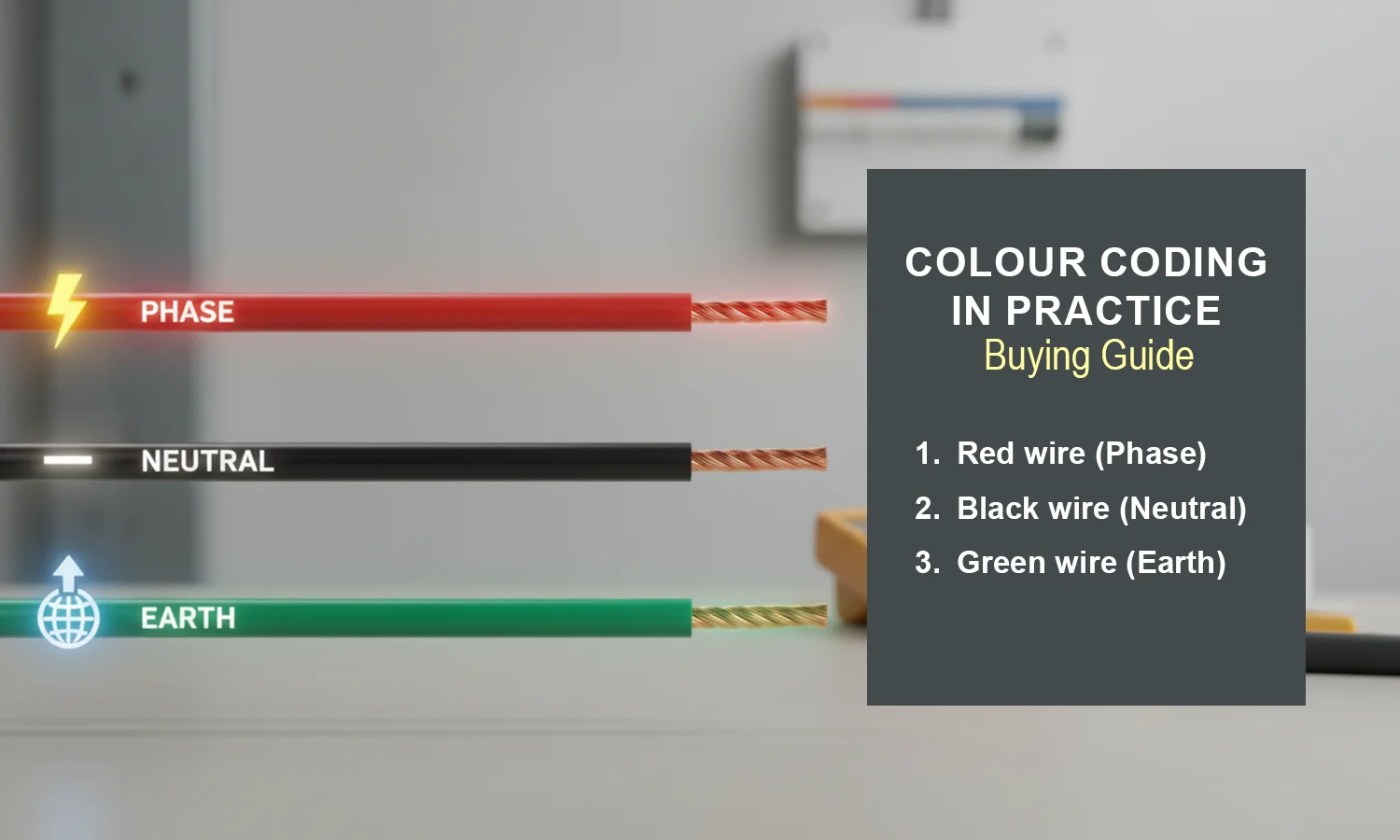
Colour Coding in Practice: Buying Guide
When purchasing wire for a home, you need to buy separate colour wires for each conductor type. Most electricians buy three colours in each required gauge:
1. Red wire (Phase): One reel per circuit for phase conductors
2. Black wire (Neutral): One reel per circuit for neutral conductors
3. Green wire (Earth): One reel (often 1.5 sq mm for lighting, 2.5 sq mm for power circuits)
Kundan Cab House wire FR and FRLSH wires are available in Red, Black, Green, Yellow, and Blue, all colour formulations compliant with IS 694:2010. Visit https://www.kundancab.in/products/house-wires/safety-pro to select by colour and gauge.
What Happens If Wrong Colours Are Used?
                Wrong Colour Usage
                Risk


                Phase wire in neutral colour (black)
                Electrician believes wire is neutral — touches live wire — electrocution risk


                Neutral in earth slot
                Equipment chassis becomes live under fault — fatal shock on appliance touch


                Earth wire connected to phase
                Entire appliance casing energised — extreme electrocution hazard


                No colour consistency across rooms
                Future maintenance confusion — electrical faults harder to trace safely
FAQs
1. What colour is the phase wire in India?
In single-phase systems, the Phase (Live) wire is RED. In three-phase systems, the three-phase wires are Red (R), Yellow (Y), and Blue (B), per IS 694:2010.
2. What colour is the earth wire in India?
Earth wire in India is GREEN, or Green with a Yellow stripe (Green/Yellow). This is consistent with IS 694:2010 and IS 3043 (Code of Practice for Earthing).
3. Does the colour code differ between FR and FRLSH wire?
No. The colour code is identical for both FR and FRLSH variants. It is determined by the wire's role in the circuit (Phase/Neutral/Earth), not by its fire safety grade.