Walk into a hardware store and ask for "electrical wire," and you will immediately be asked: "FR or FRLSH?" Most buyers say "FR" because it is cheaper, without actually knowing what they are giving up. A small number say "FRLSH" for everything, sometimes unnecessarily. Both decisions can be wrong.
The distinction between FR (Flame Retardant) and FRLSH (Flame Retardant Low Smoke) wire is one of the most important and misunderstood decisions in electrical project planning. This guide, from Kundan Cab, manufacturers of both variants to IS 694:2010 standards since 1968, will settle this definitively.
What is FR Wire?
FR stands for Flame Retardant. The PVC insulation compound used in FR wire is formulated to resist ignition from an external flame source and to self-extinguish once the ignition source is removed. Under IS 694:2010, FR wire must pass the vertical flame propagation test, meaning flame spread along the wire must be contained within defined limits.
FR wire is perfectly suitable for standard residential wiring in individual homes, villas, and independent houses. In these settings, if a short circuit ignites insulation, the fire is typically localised, and the building structure provides additional fire resistance. FR wire meets the IS 694 requirement and carries the BIS ISI mark.
What is FRLSH Wire?
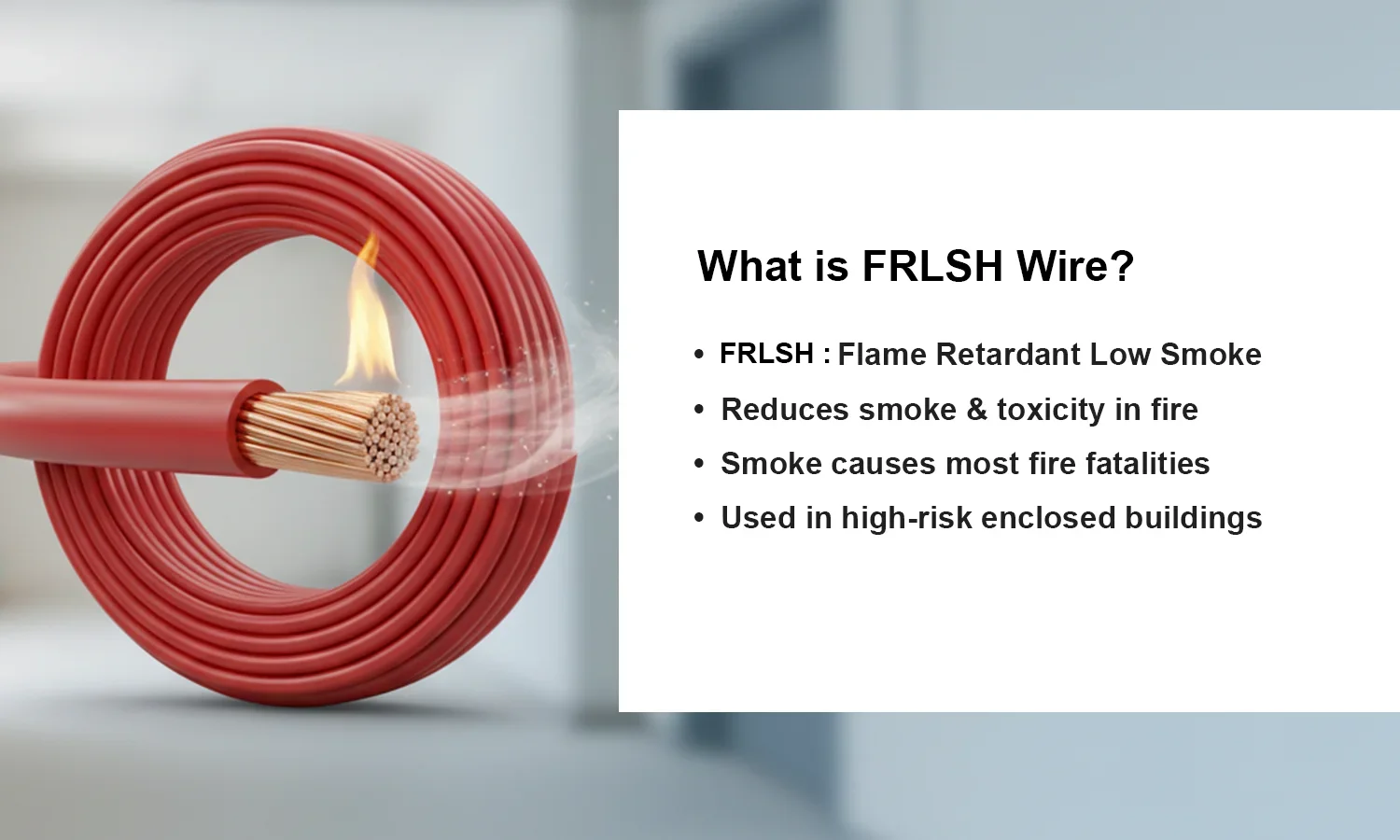
FRLSH stands for Flame Retardant Low Smoke. It does everything FR wire does, but its PVC compound is additionally formulated to dramatically reduce the volume and toxicity of smoke emitted during combustion.
Why does smoke matter so much? Because in a building fire, 80% of fatalities are caused by smoke inhalation, not direct flame. Dense, toxic smoke from burning FR-PVC wire in enclosed corridors like hospitals, shopping centres, school buildings, and high-rise apartments disorients occupants, causes respiratory failure, and prevents evacuation. FRLSH wire's low-smoke formulation provides critical additional minutes for safe egress.
HRFR: The Third Variant
HRFR (Heat Resistant Flame Retardant) wire combines FR properties with a higher continuous temperature rating, typically 90°C or 105°C versus 70°C for standard FR/FRLSH. HRFR is used in industrial environments, proximity to heat sources, and premium residential/commercial projects where longevity under high ambient temperatures is important.
                Property
                FR Wire
                FRLSH Wire
                HRFR Wire


                Flame Retardancy
                Yes
                Yes
                Yes


                Low Smoke Emission
                No
                Yes (IS 694 FRLSH test)
                Yes


                Low Toxic Gas (HCl)
                No
                Reduced
                Reduced


                Continuous Temp Rating
                70°C
                70°C
                90°C / 105°C


                Price Premium (vs FR)
                Base price
                +10–15%
                +20–30%


                NBC 2016 Mandate
                Residential only
                Public buildings
                Hazardous zones
National Building Code (NBC) 2016: What It Mandates
India's National Building Code 2016 is unambiguous. It strongly recommends FRLSH wire for all wiring in public/occupancy buildings, including hospitals, schools, hotels, multiplexes, offices, malls, and multi-storey residential buildings. This is not just a recommendation for new builds; state-level electrical inspectors increasingly check for FRLSH compliance during safety audits of existing commercial buildings.
The Practical Decision Rule
Independent homes (bungalows, villas, row houses, standalone buildings): FR wire is entirely appropriate and cost-effective. Apartment buildings: FRLSH in common areas (corridors, lobbies, staircases) and recommended in individual flats. Any public/commercial/institutional building: FRLSH is mandatory per NBC 2016. Hazardous industrial environments: HRFR.
FAQs
1. Is FRLSH wire better than FR for home use?
FRLSH is safer, but FR is adequate for standalone residential homes. If your home is in a multi-storey apartment building, FRLSH is a worthwhile upgrade, especially for kitchen and main circuit wiring.
2. Can FR and FRLSH wire be mixed in the same installation?
Yes, provided each section meets the requirement for its zone. A common practice is to use FRLSH for main distribution circuits and corridors, and FR for branch circuits within individual rooms. Label all circuits clearly.
3. Does Kundan Cab make both FR and FRLSH wire?
Yes. Kundan Cab House wire is available in FR and FRLSH variants, both IS 694:2010 compliant, in gauges from 1 sq mm to 10 sq mm. See the full range at kundancab.in/products/fr-wire.