ISI Certification Is Not a Marketing Badge — It Is a Safety Mandate
The ISI mark on an electrical wire is not like a hotel star rating or a quality badge a brand gives itself. It is a third-party, government-mandated certification by the Bureau of Indian Standards (BIS). For electrical wires, ISI certification under IS 694:2010 is not optional. It is legally required for all PVC-insulated cables used in permanent electrical installations in India.
And yet, estimates suggest that 15–25% of the electrical wire sold in India's unorganised market is non-ISI certified, often containing aluminium fillers in the conductor, sub-standard PVC that cracks at 40°C, and insulation that peels within two years.
Kundan Cab has carried the ISI mark for every wire it manufactures since 1968, a 56-year track record of BIS compliance. This guide explains exactly what that means for you.
What Is IS 694:2010 — The Wire Bible
IS 694:2010 is the Indian Standard for PVC Insulated Cables for Working Voltages Up to and Including 1,100 Volts. Published by the Bureau of Indian Standards, it specifies:
- Minimum conductor cross-sectional area and resistance values
- Insulation compound formulation and minimum thickness
- Voltage test requirements (1,100V AC for 5 minutes, no breakdown)
- Flammability test requirements (vertical flame propagation test)
- Hot set test for PVC insulation (resistance to heat deformation)
- Cold bend test (wire must not crack at -5°C)
- Tensile strength and elongation requirements for insulation
- Colour coding requirements for Phase, Neutral, and Earth conductors
Any wire bearing the ISI mark has been tested and certified compliant with all the above requirements. BIS audits manufacturing facilities twice per year (minimum), unannounced, to verify ongoing compliance.
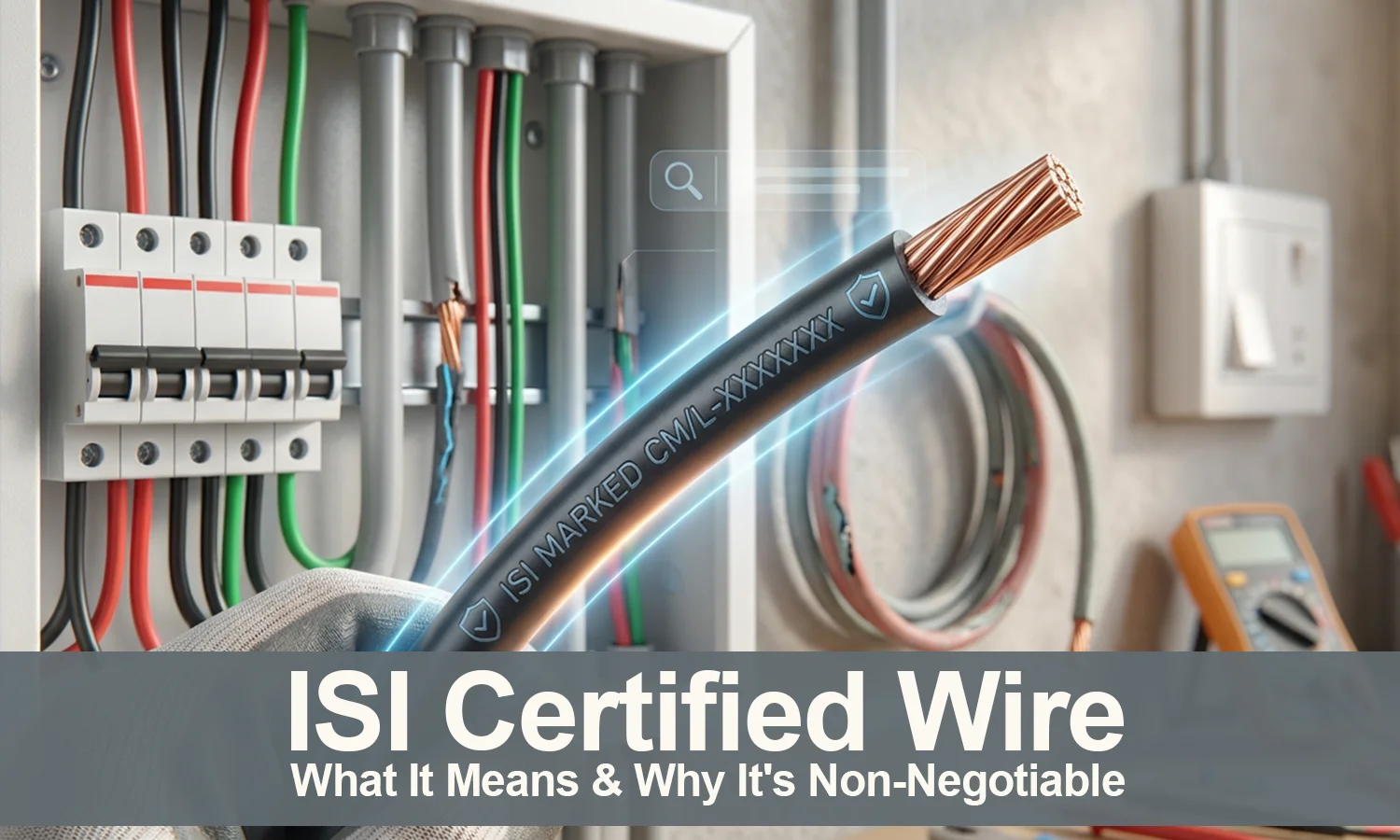
What the ISI Mark Looks Like — How to Read It
                Element on Wire Jacket
                What It Means


                ISI Logo (the BIS mark symbol)
                Wire is BIS-certified under IS 694


                IS 694:2010
                Complies with the current Indian Standard for PVC cables


                CM/L-XXXXXXX
                Manufacturer's BIS Licence Number — unique to each factory


                2.5 FRLSH or 1.5 FR etc.
                Conductor size and insulation type


                1100V
                Maximum working voltage rating


                Date Code (e.g., Q1 2026)
                Quarter and year of manufacture


                Manufacturer Name & Location
                Traceable to the licensed factory
Critical Safety Note on Marking
All these elements must appear at regular intervals (every 1–2 metres) along the entire wire length. If the markings are absent, smudged, or only on packaging and not on the wire itself, reject the batch.
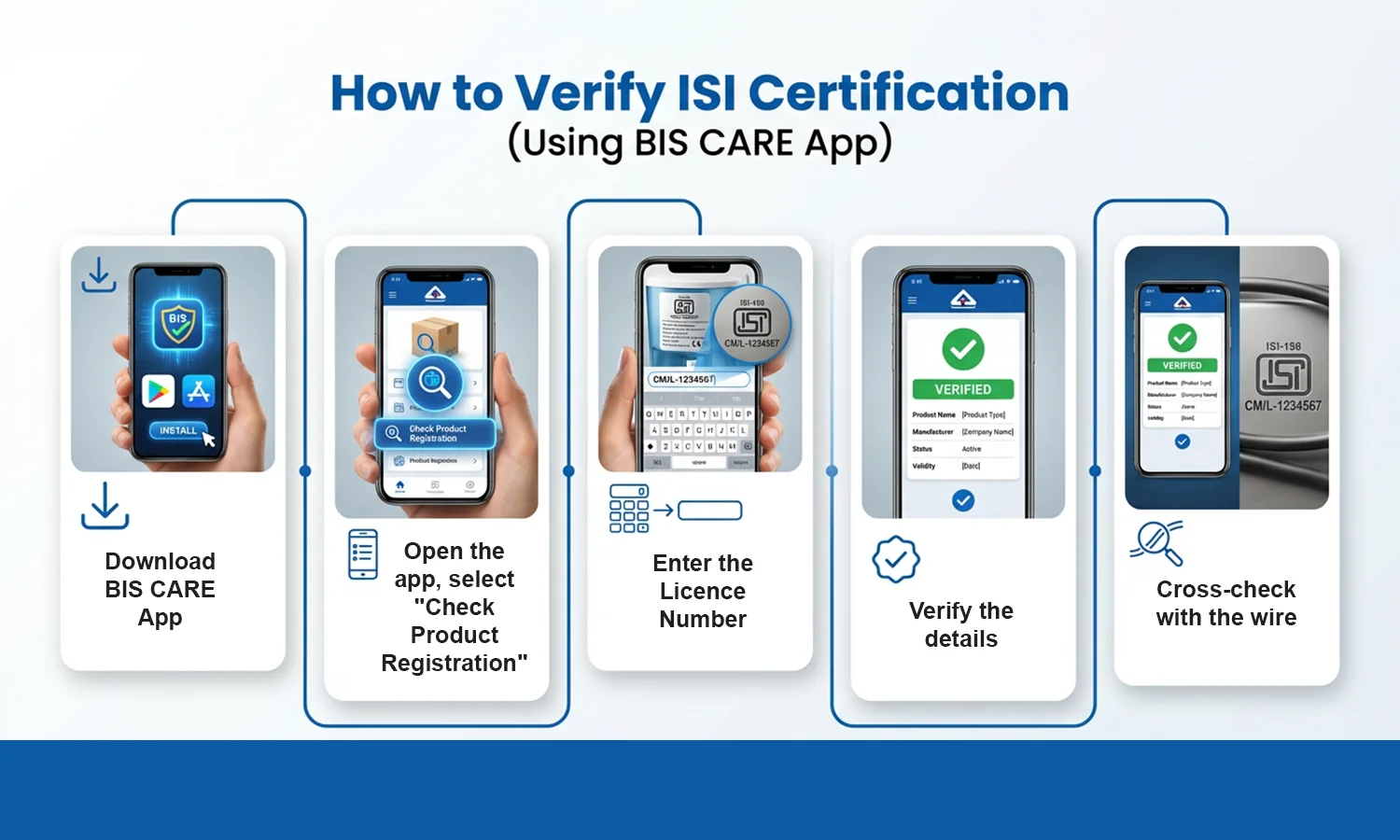
How to Verify ISI Certification Using the BIS CARE App
The Bureau of Indian Standards launched the BIS CARE mobile app (available on Android and iOS) specifically to help consumers verify product certifications. Here is how to use it for wire verification:
1. Download BIS CARE App: Available for free on Google Play Store and Apple App Store
2. Open the app, select "Check Product Registration": Choose the "Licensed Products" option
3. Enter the Licence Number: This is the CM/L number printed on the wire (e.g., CM/L-1234567)
4. Verify the details: The app will show the manufacturer name, factory address, licensed product category, and licence validity
5. Cross-check with the wire: The company name on the app must match the name printed on the wire sheath
Kundan Cab's BIS licence number is printed on every House wire coil. You can verify it in the BIS CARE App anytime. For direct verification, contact us at kundancab.in/contact.
Risks of Using Non-ISI Wire
                Risk Category
                What Happens With Non-ISI Wire


                Conductor Fraud
                Aluminium strands mixed with copper, or reduced diameter copper — lower conductivity, higher heat at same current


                Insulation Failure
                Substandard PVC cracks under heat (common in Indian summer), exposing live conductors inside walls


                Fire Risk
                Non-ISI insulation has no guaranteed flame retardancy — a spark can propagate along the entire cable run


                Electrical Safety
                Non-IS694 wire may not withstand the 1,100V insulation test — insulation failure under surge conditions


                Insurance Invalidity
                Most home insurance policies exclude fire claims caused by non-compliant electrical installations


                Legal Liability
                Use of non-ISI wire in permanent installations violates Indian Electricity Rules, 2005 — punishable offence


                Warranty Void
                Appliance manufacturers can void product warranties if non-standard wiring is discovered during a fault claim
FAQs
1. How to identify genuine kundan cab products (2026) ?
To identify Genuine Kundan Cab Products, check the packaging, the authenticity seal, the QR code and buy only from authorised dealers. Counterfeit wires that copy a trusted name can be dangerous, because they often hide underweight conductors and poor insulation. Verifying the genuine, original product protects both your home and your money.
2. Is the ISI mark mandatory for all electrical wires in India?
Yes. The Quality Control Order (QCO) issued by the Ministry of Commerce and Industry mandates BIS certification (IS 694:2010) for PVC-insulated cables used in permanent electrical installations. Uncertified wire cannot legally be sold or used in Indian buildings.
3. How can I tell if the wire has a genuine ISI mark or a fake one?
Genuine ISI wire has the BIS hallmark printed continuously along the wire sheath, not just on the packaging. Cross-check the CM/L licence number using the BIS CARE App. A licence number that does not return a valid result in the app is either fake or expired .
4. How long has Kundan Cab been ISI certified?
Kundan Cab (Balar Marketing Pvt. Ltd.) has held continuous BIS certification for wire manufacturing since 1968, for over 56 years. All House wire FR, FRLSH, and HRFR wires are manufactured under an active BIS licence. Explore the product range at kundancab.in/products.
5. Can non-ISI wire be used for temporary wiring?
Temporary installations (construction sites, events, etc.) are also required to use ISI-certified wire under IE Rules 2005. The "temporary" framing is not exempt from safety requirements, especially given that temporary wiring is often the most exposed to damage and mishandling.