Overview
A 2.5 mm wire price depends on a larger copper conductor, the insulation and the coil length, not the size alone. A 2.5 mm wire feeds power sockets and small appliances. The fair way to judge the price is to match the metal, the build and the grade before you compare two options.
The 2.5 mm wire is where home wiring starts to carry real power. It runs the socket circuits that feed everyday appliances, a clear step above the lighting sizes. That extra duty comes from more copper in every metre, which is why it costs more than the smaller sizes.
Read as a specification, the price makes sense at once. A 2.5 mm wire is a set conductor for a set load. For the bigger picture across every size, see what really sets a wire price.
What the 2.5 mm Size Carries
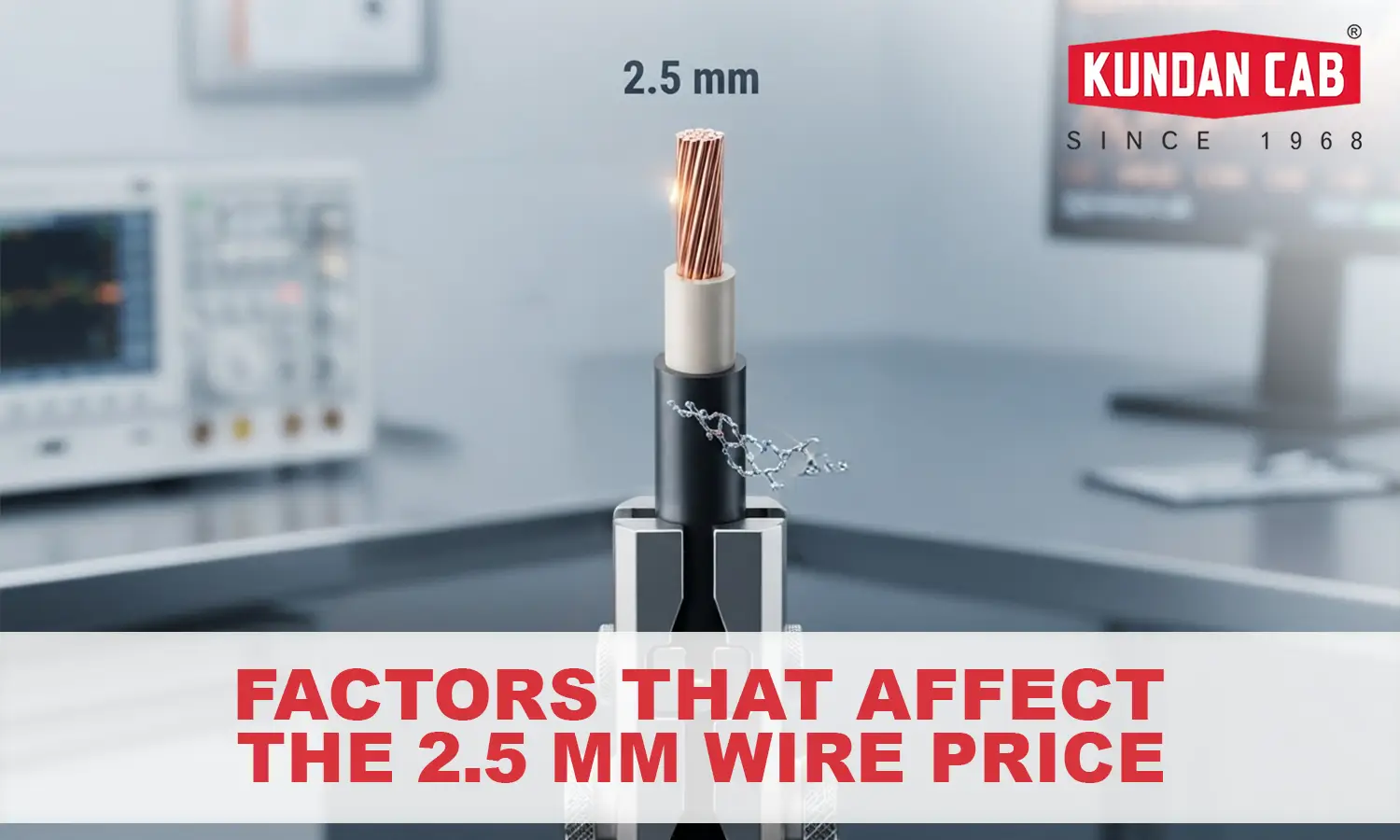
The 2.5 mm is the copper area inside, two and a half square millimetres. That area carries around twenty amperes, which suits power sockets and small appliances. It is the size most socket circuits are built around, because it has the headroom that lighting wire does not.
What Moves the 2.5 mm Copper Wire Price
A few clear things set the 2.5 mm copper wire price. Reading them off the reel tells you why two that look the same can cost differently.
- Copper quality: The purity and amount of the metal. More copper and higher purity both lift the price and improve performance.
- Insulation grade: The cover around the copper. Plain PVC is the base, while FR and FR-LSH grades add fire safety and a little cost.
- Coil length: The metres on the reel. A longer coil holds more wire, so the total is higher.
- Brand and standard: A trusted brand built to IS 694:2010 carries a quality that a plain wire 2.5 mm price does not show.
2.5 mm Wire Per Metre and on a 90 Metre Coil
Buyers often look for a 2.5 sq mm wire price per meter, but wire is sold on a coil, so a per metre figure is really the coil total shared across its metres. When you see a 2.5 mm wire price 90 mtr, that is the whole ninety metre coil. Work out the metres your job needs first, then the coil that fits is the fair buy rather than the one that simply looks cheaper.
Where 2.5 mm Wire Is Used
A 2.5 mm wire is the socket circuit size. Power points, small kitchen appliances and general socket runs all sit on it. It carries more than a lighting wire, which is why sockets are wired at this size rather than a thinner one. Heavier dedicated loads move up again to 4 mm.
2.5 mm Wire vs 4 mm Wire
The next question is if a circuit needs 2.5 mm or a step up to 4 mm. The table makes the choice clear.
| Point | 2.5 mm wire | 4 mm wire |
|---|---|---|
| Copper area | 2.5 sq mm | 4.0 sq mm |
| Rough current | About 20 A | About 26 A |
| Best for | Sockets and small appliances | Geysers and heavier points |
Sockets and small appliances sit well on 2.5 mm. A geyser or another heavy point usually wants a 4 mm wire for its extra capacity. Match the size to the load, and compare only wires of the same size and grade.
How to Choose the Right 2.5 mm Wire
Once the size suits the load, a quick check keeps the choice sound.
- Confirm the copper is high purity and the correct area.
- Pick the insulation grade the space needs, FR or FR-LSH.
- Check the coil length so you know the metres you are buying.
- Look for a clear standard marking such as IS 694:2010.
Kundan Cab 2.5 mm Wires and Cables
The 2.5 mm size has a verified home in the Kundan Cab range. Its Copper CTS 4 X Single Core is listed from 2.5 sq mm to 4.0 sq mm, built to IS 694:2010 in electrolytic grade annealed copper rated to 1100 volts, for heavy single core runs. The size also sits within house wires such as Safety Pro and Flexy Plus for home sockets.
So there is a clear split. For a home socket circuit, an FR or FR-LSH house wire at 2.5 mm fits, while heavier single core work points to the Copper CTS 4 X range. When several cores are bundled, the discussion moves to the way a cable is priced. See the full Kundan Cab range for every size.
FAQs
1. What is a 2.5 mm wire used for?
A 2.5 mm wire is used for power socket circuits and small appliances, carrying around twenty amperes. It has more capacity than a 1.5 mm wire, which is why sockets are wired at this size. A 2.5 mm wire price should be judged against a socket or small appliance load.
2. Why is a 2.5 mm wire dearer than a 1.5 mm wire?
Because it holds more copper. A 2.5 mm conductor has a larger area than a 1.5 mm one, and since copper is the main cost, more metal lifts the 2.5 mm copper wire price directly. The larger size also carries a heavier load, so the extra cost buys real capacity.
3. Does Kundan Cab make a 2.5 mm wire?
Yes. Kundan Cab lists 2.5 sq mm within its Copper CTS 4 X Single Core range, and the size also sits within house wires such as Safety Pro and Flexy Plus. All are high purity copper to IS 694:2010. Confirm the product and length, then ask a Kundan Cab dealer for the current price.
Key Takeaways
- A 2.5 mm wire price is set by the larger copper conductor, the insulation and the length, not the size alone.
- The 2.5 mm is a two and a half square millimetre copper area, suited to sockets and small appliances.
- A per metre figure is really the coil total shared across its metres, so check the coil length.
- For heavier dedicated points, step up to 4 mm rather than stretch a 2.5 mm wire.
- Kundan Cab covers 2.5 sq mm in Copper CTS 4 X and in house wires like Safety Pro and Flexy Plus, all to IS 694:2010.
Wiring socket circuits? Decide the copper grade, the insulation and the length you need at 2.5 mm, then ask a Kundan Cab dealer for the current price. Visit kundancab.in to match the right product to your circuit and enquire for live details.